
MESSAGE FROM THE PRESIDENT
It is with great pride and gratitude that I present this annual report outlining our achievements under the project titled “Improving Quality of Life and Sustainable Development” in Banke and Bardiya districts.
This year, WACD has continued its mission to empower marginalized communities—particularly Tharu indigenous communities, marginalized vulnerable groups, ex-Kamaiya families, women, and children—through a comprehensive approach focused on sustainable livelihoods, health, education, and social inclusion. From establishing Model Villages, promoting high-value agriculture and micro-enterprises, to preserving indigenous skills and improving community health awareness, each intervention reflects our commitment to building resilient and self-reliant communities.
These achievements were made possible through the collective efforts of our dedicated team, community partners, and stakeholders at every level. I would like to extend my heartfelt thanks to Community Partners International (CPI) and all local government bodies for their unwavering support and collaboration.
As we move forward, WACD remains committed to deepening our impact, uplifting the most vulnerable, and advocating for inclu“Improving Quality of Life and SustainableDevelopment”
With sincere appreciation,
Tilak Ram Tharu
President
Women and Child Development (WACD)
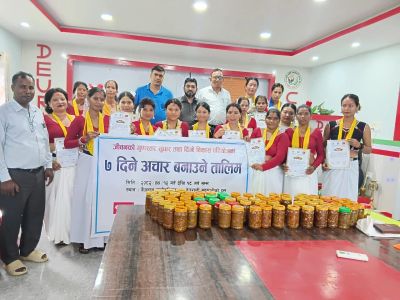
1.1: Pickle-making training, micro industry established, and support sealing machine in the Banke District:
WACD conducted a 7-day intensive pickle-making training for 16 women farmers from the Pragatishil Women Development Farmers Group in Baijanath Rural Municipality, Ward No. 3, Banke. The training aimed to strengthen women’s technical skills and promote sustainable livelihood opportunities through small-scale food processing enterprises.
Participants learned to produce six varieties of pickles and collectively prepared 85 cans during practical sessions. With strong support from local leaders, including commitments for product purchase and transportation, the women were able to access nearby markets. Immediately after the training, the group sold 55 cans, generating NPR 8,250 (USD 61), demonstrating the strong market potential of their products.
Following the training, the group has continued collective production and sales within local and neighboring markets, reflecting the sustainability and scalability of the initiative. The program significantly improved participants’ technical capacity, confidence, hygiene practices, and entrepreneurial skills, enabling them to independently manage and expand their micro-enterprise. This activity has contributed to women’s economic empowerment and strengthened community-based income generation in the target area.
1.2 Vegetable Grading, Packaging, and Storage Training (Banke and Bardiya)
WACD organized two 2-day trainings on vegetable grading, packaging, and storage in Banke and Bardiya districts, benefiting a total of 65 farmers (61 women and 4 men). The sessions were conducted for women-led farmer groups in Barbardiya Municipality, Ward No. 10, Bardiya, and Baijanath Rural Municipality, Ward No. 3, Banke, in September 2025.
Facilitated by technical experts from the respective local governments, the trainings aimed to strengthen farmers’ capacity to improve product quality, reduce post-harvest losses, and enhance market competitiveness. Participants gained practical skills in proper grading, packaging, and long-term storage techniques, enabling them to secure better prices during both peak and off-season periods.
This intervention contributed to improved market access, increased income potential, and strengthened commercialization of smallholder farming, particularly for women farmers, supporting sustainable livelihoods in the target communities.

1.3 Training on Integrated Fish Pond Farming – Bardiya
A three-day practical training on integrated fish pond farming was conducted from November 23 to 25, 2025, in Barbardiya Municipality, Ward No. 10, Bardiya. The training equipped 16 community members (7 men and 9 women) with essential knowledge and skills in pond construction, sanitation, feeding practices, and sustainable fish farming techniques to effectively manage a 4-hectare natural pond.
Participants were also trained in integrating high-value crops such as banana, chilli, and moringa around the pond area to diversify production and maximize land use. This integrated approach promotes both food security and income generation.
The initiative is expected to directly benefit 122 households and indirectly support 635 community members by establishing a sustainable source of livelihood through fish farming and complementary agriculture. In addition, the training encouraged the responsible use of community forest resources, balancing income generation with environmental conservation.
The program also enhanced awareness of the nutritional and economic value of moringa and other crops, contributing to improved household nutrition and increased access to local market opportunities.
Impact of the project:
- The project strengthened livelihood opportunities, especially for women farmers, through skill development and practical enterprise support.
- Income generation, local market engagement, and sustainable practices have been established.
- Enhanced capacity in vegetable handling, grading, and packaging supports improved market access and better profitability.
- Strong engagement of local leaders and technical experts ensures ongoing support, sustainability, and potential for scaling these initiatives in the target communities.
- The local governance bodies (Rural/Municipality) and surrounding village communities recognize the area as the target Model Village
Learnings from the project:
- Hands-on training combined with market support creates sustainable livelihood opportunities.
- Engagement of local leaders, technical experts, and community support strengthens project outcomes.
- Continuous capacity building, follow-up, and guidance are essential for long-term success in income-generating and agricultural activities.

